
The Rule of Thumb
If your garage door reverses before it touches the ground, or refuses to close and just sits there blinking its opener light, assume the photo-eye sensors are dirty, misaligned, or blocked before you assume anything else is broken. That one check solves the majority of "my door won't close" calls. The exceptions: if the door won't open at all, that's almost never the sensors (they only govern closing); if your remote has stopped working entirely, that's a transmitter or receiver issue; and if the sensor lights look solid and aligned but the door still refuses to close, you may be dealing with a travel-limit setting or a logic board problem on the opener itself, which is a different repair.
What the Sensors Actually Do
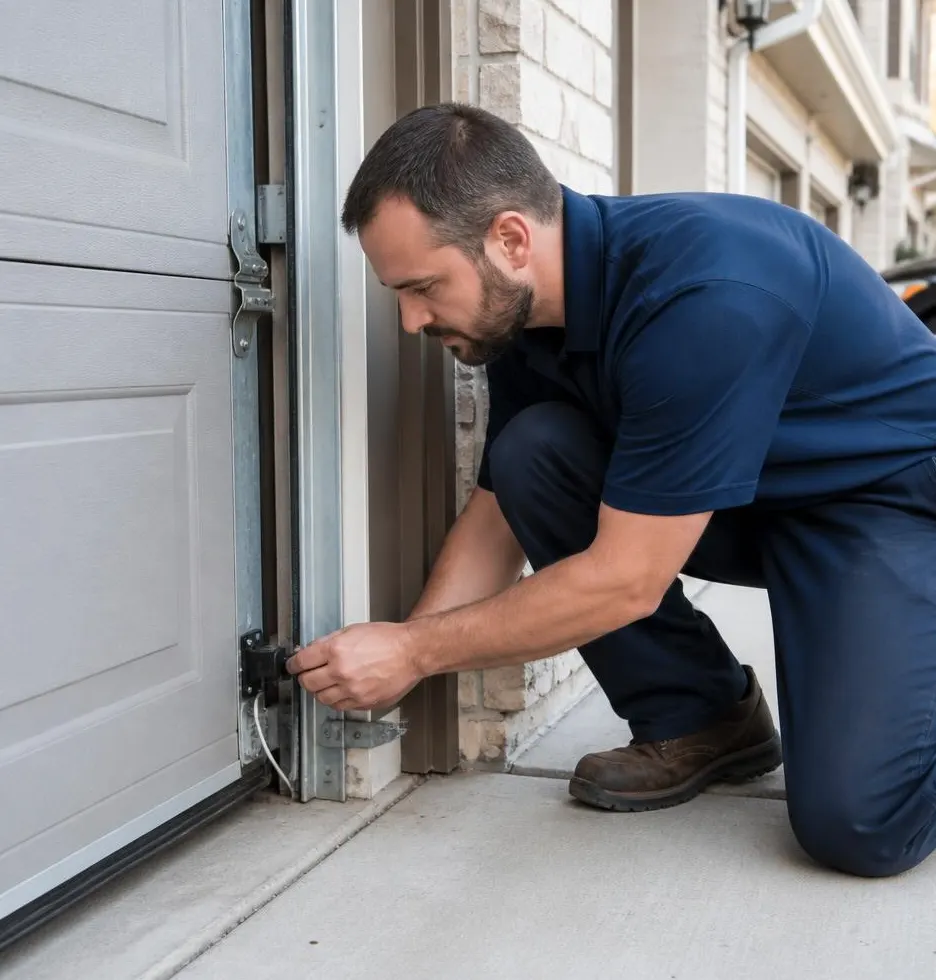
Photo-eye sensors are the two small boxes mounted a few inches off the garage floor, one on each side of the track. They shoot an invisible infrared beam across the opening. As long as that beam is unbroken, the opener is told it's safe to close the door. If something breaks the beam, a pet, a stored bike, a stray tennis ball, a pine branch that fell in the opening, the opener reverses the door immediately. This system has been required on residential openers since the mid-1990s specifically because garage doors used to crush things and people that were in the way, often without the door ever slowing down.
How It Goes Wrong, and How Badly
When a photo-eye fails, it fails in one of two directions, and only one of them is obvious.
- Fail-safe (the common, annoying version): the door won't close, or it closes a few inches and reverses. Frustrating, but harmless. This is the version most homeowners experience and complain about.
- Fail-unsafe (the dangerous version): a sensor gets knocked out of alignment just enough that it still shows a solid light, but its field of view is pointed at the wall, the floor, or past the opposite sensor instead of straight across the opening. The door now closes normally in every test you run, right up until a child, pet, or garden hose is in the doorway and the door doesn't stop. This is the scenario the sensors exist to prevent, and it's also the scenario that happens when people get frustrated with nuisance trips and nudge, re-point, or tape the sensors into a position that "makes the light turn green" without actually fixing the alignment.
Why Photo-Eyes Act Up More Here Than in Drier Climates
A few things specific to this area make photo-eye problems more frequent than the national average:
- Humidity and condensation: On muggy mornings, moisture can fog the sensor lenses just enough to weaken the beam, especially in detached garages or units without good air movement.
- Pollen season buildup: Heavy pine and seasonal pollen settles on everything, including sensor lenses, forming a thin film that's easy to miss by eye but enough to scatter the infrared beam.
- Spiders and insects: Garages attract webs, and a web spun directly across a sensor lens or in front of it will absolutely trigger false reversals.
- Vibration from heavy rain and storms: Hard rain, wind, and the occasional remnant of a tropical system can rattle the garage door track enough over time to nudge sensor brackets out of true alignment, particularly on older installations where the mounting screws have loosened.
- Ice storm aftermath: Less frequent here, but when it happens, a quick temperature swing and any accidental bump to the sensor housing while de-icing a door can throw off alignment that worked fine the day before.
Cleaning and Aligning Them Yourself
This is one of the few garage door jobs that's genuinely safe and simple for a homeowner to do:
- Locate both sensors. They sit a few inches above the floor on either side of the opening, usually with a small LED on each.
- Wipe each lens with a soft, dry microfiber cloth. Don't use glass cleaner or anything with ammonia, it can leave a film. If there's heavier grime or pollen residue, a slightly damp cloth followed by a dry one works better.
- Check both LEDs with the door open. Most systems show solid lights on both sensors when aligned correctly; a flickering or dim light on either side usually means misalignment, not a dirty lens.
- Loosen the wing nut or mounting screw on one sensor and gently adjust it up, down, or side to side in small increments until both LEDs read solid.
- Test with a full close-and-open cycle, then test again by waving a broom handle through the beam partway through a close cycle. The door should stop and reverse immediately.
- Clear the area in front of both sensors of stored items, leaning tools, or anything at that low height, since even non-blocking clutter nearby can cast reflections that confuse the beam.
Why You Shouldn't Bypass Them
Some older opener models and aftermarket wiring tricks can jump the safety circuit so the door closes with the sensors disconnected or ignored. Don't do this, and if a door you've bought or inherited already has this done, have it corrected. A bypassed photo-eye isn't a shortcut around a nuisance, it's a garage door with several hundred pounds of travel force and no way to stop itself if something or someone is underneath it. The few minutes it takes to clean and realign a sensor is a much better trade than removing the one feature designed to prevent a crushing injury.
When to Call Augusta Garage Door Pro
If you've cleaned and realigned the sensors and the door still won't close reliably, or if the LEDs won't hold a solid light no matter how you adjust the bracket, the sensor unit itself may be failing, or the wiring running to it may have corroded or chafed where it enters the garage. Our technicians handle this as part of standard Garage Door Repair, testing the full safety circuit rather than just swapping a part and hoping. It's also worth adding a sensor check to your Preventive Maintenance visit each year, since catching a loose bracket or a hairline crack in a lens before pollen season or the next heavy storm run is a lot cheaper than an emergency call.
If your garage door in Augusta, Martinez, Evans, Grovetown, Hephzibah, North Augusta, Aiken, or Fort Eisenhower won't close, or you're not sure if those sensors are actually protecting your family, call Augusta Garage Door Pro and we'll get it checked and working safely.